spin-off 1
Writer K
The fluorescent lights of Mercy General's trauma center cast harsh shadows across my face as I stood at the entrance, taking in the controlled chaos before me. My first day as department head, and already the air crackled with a familiar intensity that reminded me of field hospitals in conflict zones. The difference here was the symphony of beeping monitors and squeaking gurney wheels instead of distant explosions.
"Multiple GSWs coming in! ETA two minutes!" A nurse's voice cut through the cacophony.
I pulled my hair back into a tight bun, muscle memory from countless similar moments. The weight of my new ID badge felt foreign against my chest, "Dr. Kalliope Vasilakis, Trauma Center Director" catching the sterile light.
"Someone page respiratory!" Another voice echoed through the department. The controlled panic in their tone told me everything I needed to know about the state of this place. Mercy General's reputation for being understaffed and overwhelmed wasn't exaggerated.
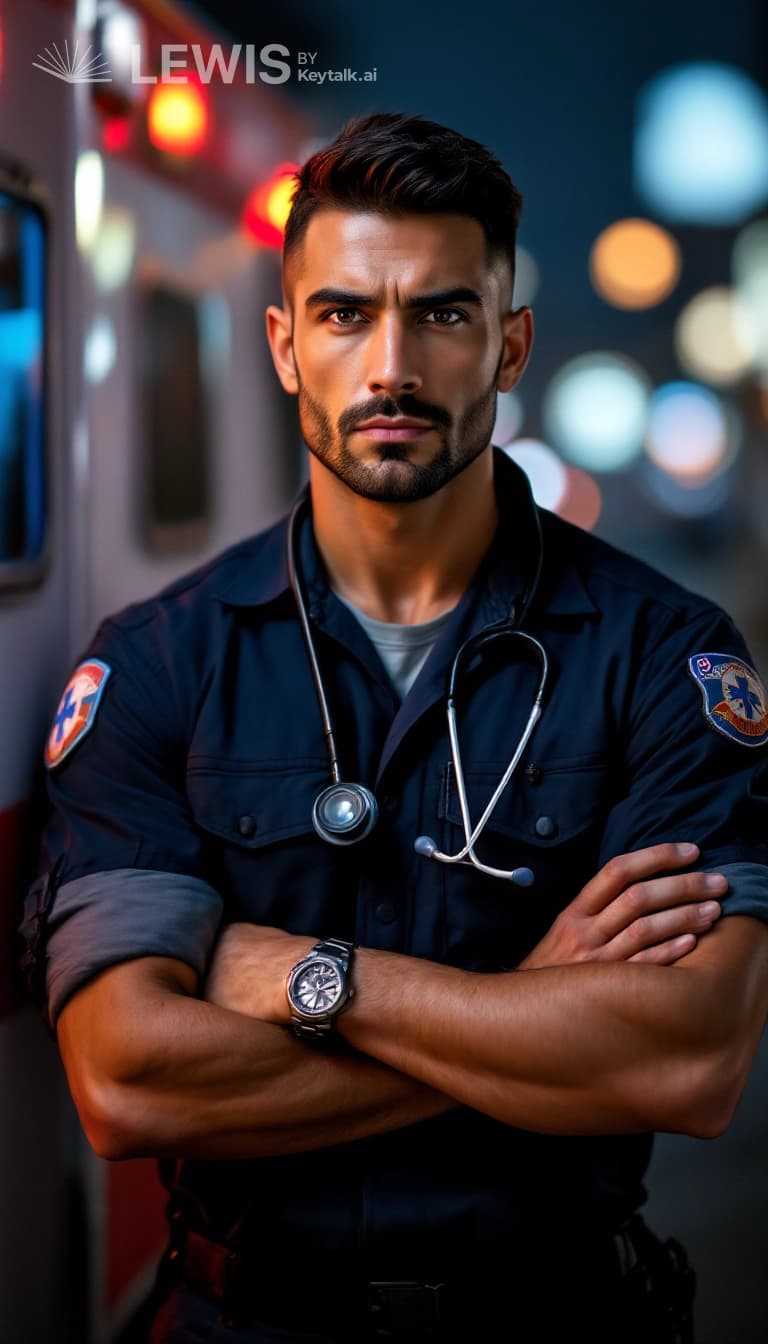
The double doors burst open, and I got my first glimpse of him – Leonidas Kouris. His paramedic uniform was splattered with blood, muscles tensed as he guided a gurney through the entrance. Our eyes met for a fraction of a second, and I caught a flash of something – recognition, perhaps, or challenge – before he launched into his report.
"Male, mid-twenties, three gunshot wounds – chest, abdomen, and right thigh. BP's dropping, lost consciousness en route." His voice was deep, authoritative, but with an underlying gentleness that seemed at odds with his imposing physique.
I stepped forward, already pulling on gloves. "Bay three. Get me an ultrasound and type and cross for six units." The staff hesitated for a moment, unused to my command. "Now!"
The patient's shirt had been cut away, revealing tattoos and entry wounds that told their own story of street life. I pressed my stethoscope to his chest, detecting decreased breath sounds on the right. "Tension pneumothorax. I need a chest tube kit."
"Who are you?" A resident stood frozen, clutching a chart.
"Your new boss," I replied, not looking up as I palpated the abdomen. "And unless you want this patient to die in the next five minutes, I suggest you move."
Leo – Kouris, I corrected myself mentally – hadn't left. He stood at the foot of the bed, his presence solid and grounding amid the frenzy. "He crashed once in the bus. Brought him back with epi."
I nodded, appreciating the additional information while my hands worked automatically, finding landmarks on the patient's chest wall. The familiar grip of the scalpel centered me as I made my incision. "Bullet likely nicked the pulmonary artery. We need to get him to the OR now."
"OR 2 is prepped," a nurse called out.
"Good. Let's move." I glanced up, catching Leo's gaze again. This time, I saw something else there – respect, maybe, mixed with curiosity. He helped transfer the patient to the OR gurney, his movements efficient and precise.
As we rushed toward the operating room, the overhead lights creating strobe-like flashes across the corridor, I felt the weight of every step. This wasn't just about saving one life – it was about proving myself, about showing this struggling trauma center that I could lead them out of whatever mess they'd fallen into.
Behind me, I heard Leo's voice speaking quietly to the patient, even though the man was unconscious. It was an unexpectedly tender gesture from someone who looked like he could bench-press a car. The contrast intrigued me, but I pushed the thought aside. I had a job to do, and getting distracted by attractive paramedics wasn't part of it.
The OR doors swung open, and I stepped into my element, the sterile field a blank canvas waiting for my expertise. "Scalpel," I called out, and the weight of the instrument settled into my palm like coming home.I met the scrub nurse's eyes over my mask. "Ten blade." The cold steel settled into my waiting palm as the monitors beeped their urgent rhythm. The patient's vitals flickered on the screen – pressure still dropping despite the rapid transfusion now running.
"Come on, stay with me," I murmured, making the first precise incision. Blood welled up immediately, darker than it should be. The metallic scent hit my nostrils even through the mask, triggering memories I quickly suppressed. This wasn't a tent in Kandahar. This was Mercy General, and I had state-of-the-art equipment and a full team. If I could save soldiers with nothing but basic supplies and determination, I could save this kid.
"Retractor." I barely recognized my own voice, clipped and focused. The chest cavity opened under my hands, revealing the damage. The bullet had done exactly what I'd feared, tearing through the pulmonary artery in a way that made my jaw clench. "More suction. I need better visualization."
A commotion at the OR door drew my attention for a split second. Through the window, I caught sight of Leo still lingering, his broad shoulders tense as he watched. Our eyes met briefly through the glass, and I saw his lips move in what looked like a prayer. The gesture struck something in me – a paramedic who prayed for his patients after handoff was either naive or possessed a depth I hadn't expected.
The monitor's shriek yanked me back. "V-fib!" someone called out.
"Starting internal compressions," I announced, my hand already moving to massage the heart directly. Blood coated my gloves, warm and accusing. The first case on my first day couldn't end like this. I wouldn't let it.
"Get me 3-0 prolene and prepare the bypass machine," I ordered, my mind racing through options. "This isn't over yet."The rhythmic squish of my hand compressing the heart filled the sudden silence in the OR. Each squeeze sent a spray of blood across my gown, adding to the constellation of red dots already there. The team moved with practiced efficiency, but I could feel their uncertainty – the new boss, taking risks on a patient who might already be too far gone.
"Bypass ready," the perfusionist called out.
I nodded, never breaking the rhythm of compressions. "Temperature down to thirty-two degrees. We're going to need time to repair this mess." My fingers found the tear in the pulmonary artery, feeling its ragged edges. This would require precision I hadn't needed since my last mass casualty event in Syria.
Through the OR window, Leo's presence remained, a silent sentinel. His crossed arms and furrowed brow visible even at this distance. Something about his steadfast vigil steadied my hands, reminded me of the humanity behind the technical challenge before me.
"Dr. Vasilakis," the anesthesiologist's voice carried a warning. "BP's barely registering."
"Then we'll make it register," I replied, my accent thickening with intensity. "Get me the pledgets. We're doing this old school." My fingers moved automatically, muscle memory from countless similar repairs under worse conditions. "More suction. I need to see what I'm doing."
The first stitch went in clean, a small victory. Blood still seeped around my hands, but slower now. The bypass machine hummed, buying us precious minutes. I could feel the weight of the OR team's attention, their collective breath held as they watched their new chief tackle what might be a lost cause.
A clatter from the instrument tray broke the tension. "Sorry," the surgical tech whispered, but I barely heard her. My world had narrowed to the delicate dance of needle and thread, each suture a promise to the unconscious young man on my table. And to the paramedic who'd brought him to me, still keeping his silent vigil beyond the glass.My hands moved with practiced precision as I placed the next suture, the needle sliding through tissue with barely any resistance. The familiar rhythm of surgery settled over me, but something felt different here – more exposed, more scrutinized than any procedure I'd performed in a war zone.
"Pressure's starting to stabilize," the anesthesiologist announced, a note of surprise in his voice.
I allowed myself a small nod but kept my focus on the repair. "Another 3-0 prolene." The scrub nurse's hand appeared in my peripheral vision, instrument ready. The teamwork was there, even if tentative, uncertain of their new leader.
Through the window, Leo shifted his weight, drawing my attention for a fraction of a second. His presence was becoming a distraction I couldn't afford, yet I found myself hyperaware of his every movement. The intensity of his gaze felt almost physical, like another set of hands in the OR.
"Doctor?" The resident's voice pulled me back. "There's active bleeding from the inferior margin."
I blinked, refocusing. "I see it." My fingers found the source – a small tear we'd missed initially. "Pickup and another pledget." The words came out sharper than intended, my accent more pronounced. The team's slight hesitation told me they'd noticed.
The monitors beeped steadily as I worked, each sound a reminder of the precarious line we walked. Blood still seeped around my careful stitches, but slower now, more controlled. Like the trauma center itself, this patient was damaged but not beyond saving. The parallel wasn't lost on me.
"Starting to warm him back up," the perfusionist announced.
I nodded, placing another careful stitch. "Slowly. Let's not rush this victory." If it was a victory. Experience had taught me that celebrating too early only invited disaster. Still, I could feel the shift in the OR's atmosphere – from desperate tension to cautious hope.
Leo's shadow moved across the window again, and this time when I glanced up, our eyes locked. The intensity I found there made my hands falter for just a moment, a microsecond of hesitation that no one else would notice. But I noticed. And judging by the slight narrowing of his eyes, so did he.I turned back to my work, irritated by my own distraction. "More light," I demanded, and the surgical lamp adjusted, casting new shadows across the surgical field. The repair was holding, but the next few minutes would be crucial.
"BP's climbing," the anesthesiologist reported. "Sixty systolic."
"Not good enough," I muttered, my fingers probing for any signs of bleeding we might have missed. The tissue felt fragile under my touch, like wet paper ready to tear. One wrong move and we'd be back to square one.
A commotion outside the OR drew scattered glances from my team. Through the window, I caught glimpses of Leo arguing with someone – an administrator, judging by the suit. His gestures were controlled but emphatic, his jaw set in a way that suggested this wasn't a battle he intended to lose.
"Focus," I snapped, as much to myself as to my team. "Starting to close the pericardium." My hands moved automatically, but my mind kept drifting to the drama unfolding beyond the glass. What was so important that a paramedic would go toe-to-toe with hospital administration during his first interaction with me?
The suture needle slipped slightly in my blood-slicked fingers. I recovered instantly, but not before catching the sharp intake of breath from the resident beside me. "If you're going to faint, do it away from my sterile field," I said, not unkindly. The resident straightened, clearly determined to prove themselves.
"Pressure holding at seventy-five systolic," the anesthesiologist called out. Better, but still not where I wanted it. Outside, the argument had escalated, Leo's voice now audible through the OR doors despite their thickness. Something about protocols and patient history.
I tied off another suture, hyperaware of every heartbeat under my hands. One crisis at a time, I reminded myself. But as I reached for the next instrument, I couldn't shake the feeling that this case, this moment, was setting the tone for everything that would follow at Mercy General.The tension in my shoulders built as I worked, each suture a delicate balance between speed and precision. The metallic tang of blood grew stronger as I shifted position, my back protesting the awkward angle.
"Starting to get ectopic beats," the anesthesiologist warned. The monitor's rhythm had developed a slight stutter, like a drummer losing their tempo.
Through the window, Leo's confrontation had drawn more attention. A small crowd of nurses and orderlies gathered at the periphery, their faces a mix of concern and curiosity. The administrator's voice rose enough for fragments to penetrate the OR: "...standard procedure... liability issues..."
"Give me the internal paddles," I ordered, my voice steady despite the growing pressure. "Have them ready." The resident fumbled slightly passing them to the scrub nurse, their inexperience showing in the jerky movement.
The next suture proved troublesome, the tissue threatening to tear under even gentle pressure. I adjusted my grip, acutely aware of the sweat beginning to bead under my surgical cap. The OR lights seemed to intensify, creating halos around everything I looked at.
"Doctor," the resident's voice wavered slightly. "The inferior margin is starting to—"
"I see it," I cut them off, already moving to address the new bleeding. My hands remained steady, but inside, frustration bubbled up like bile. This should have been a straightforward repair, the kind I'd done dozens of times in worse conditions. Yet something about this case, this moment, felt different. Heavier.
The argument outside reached a crescendo. Leo's deep voice carried through clearly this time: "You don't understand. This isn't just any patient—"
The monitor's alarm cut through everything else, its urgent wail demanding attention. "V-tach," the anesthesiologist announced, tension evident in their voice.
I kept my eyes on my work, but my awareness expanded to include every detail of the room – the quickened breathing of my team, the squeak of someone's shoe on the floor, the weight of Leo's gaze through the window. The next few seconds would determine not just this patient's fate, but my authority in this department.
"Charge to twenty," I ordered, my accent thickening as it always did under pressure. The paddles waited nearby, a last resort I wasn't ready to employ. Not yet. First, I had to find the source of this new bleeding, had to prove that Mercy General hadn't made a mistake in hiring me.
The suture needle glinted under the harsh lights as I prepared my next move, the fate of more than just one life hanging by its thread.My fingers moved with deliberate precision as I located the source of bleeding, a small tear that had opened up like a betrayal beneath my earlier repair. The monitor's rhythmic beeping grew more erratic, matching the tension building in my shoulders.
"Pressure dropping again," the anesthesiologist announced. "Fifty-five systolic."
Through the window, Leo's argument had drawn the attention of a stern-looking woman in scrubs – Dr. Chen, according to her ID badge, one of the senior surgeons I'd been briefed about. She inserted herself between Leo and the administrator, her presence commanding enough to create a momentary pause in their heated exchange.
"Another 3-0 prolene," I called out, forcing my attention back to the surgical field. The scrub nurse's hand appeared with mechanical efficiency, but I caught the slight tremor in her fingers as she passed the suture. They were all watching, waiting to see if their new chief would crack under pressure.
The tissue felt impossibly delicate under my fingers, like wet silk threatening to disintegrate. I had to time this perfectly – too much pressure and it would tear, too little and the bleeding would continue. A bead of sweat rolled down my temple beneath my surgical cap.
"Doctor Vasilakis," the resident's voice carried a note of warning. "The monitor—"
"I know," I cut them off, my accent sharp enough to make them flinch. "Everyone quiet."
The OR fell silent except for the equipment's steady hum and the increasingly urgent beeping of the cardiac monitor. Through sheer force of will, I narrowed my world to the space between my hands, shutting out everything else – the watching eyes, the drama unfolding outside, the weight of expectations pressing down like a physical force.
The needle slid through tissue with practiced ease, but as I pulled the suture taut, I felt rather than saw the exact moment everything threatened to unravel.
spin-off 2
(NSFW) Heart of Mercy
(NSFW) Heart of Mercy's Story Chat
Want to chat with ?Chat with this story's characters — an AI conversation in their own voice.
More episodes
View More